Humanoids in public. Supervised, insured, deployed.
Robomodal is the operating system for public humanoid deployment: permits, safety, telemetry, insurance posture, and real-world operations—starting with supervised mobile retail (humanoid + rolling smart cooler) on San Francisco private property and permitted events, then limited sidewalk pilots.
Field log
The thesis
Humanoid robots are inevitable. The bottleneck isn’t locomotion—it’s public deployment: permits, liability, insurance underwriting, operations, and trust. The first company to build a repeatable deployment framework in a major city defines the standard and compounds advantage.
No public playbook exists
Sidewalk and public-space operations require compliance, incident response, and stakeholder alignment—today it’s fragmented and ad hoc.
Supervised retail in SF
Start where approvals are simplest: private property + permitted events, then expand to limited, controlled public pilots with attendants.
Permits + insurance + ops
We build the underwriting posture, telemetry, and operational system that makes public humanoids acceptable, scalable, and defensible.
The Robomodal platform
Robomodal is a deployment layer on top of commodity humanoid hardware—focused on safe operations, telemetry, compliance, and monetizable services in public life.
What ships first (v1)
- Humanoid interface: greet, guide, upsell, answer common questions
- Rolling smart cooler: refrigeration, locked compartments, weight sensors, internal camera
- Payments: tap-to-pay + QR, with transaction logging and fraud alerts
- Telemetry: speed, proximity events, override frequency, uptime, payments
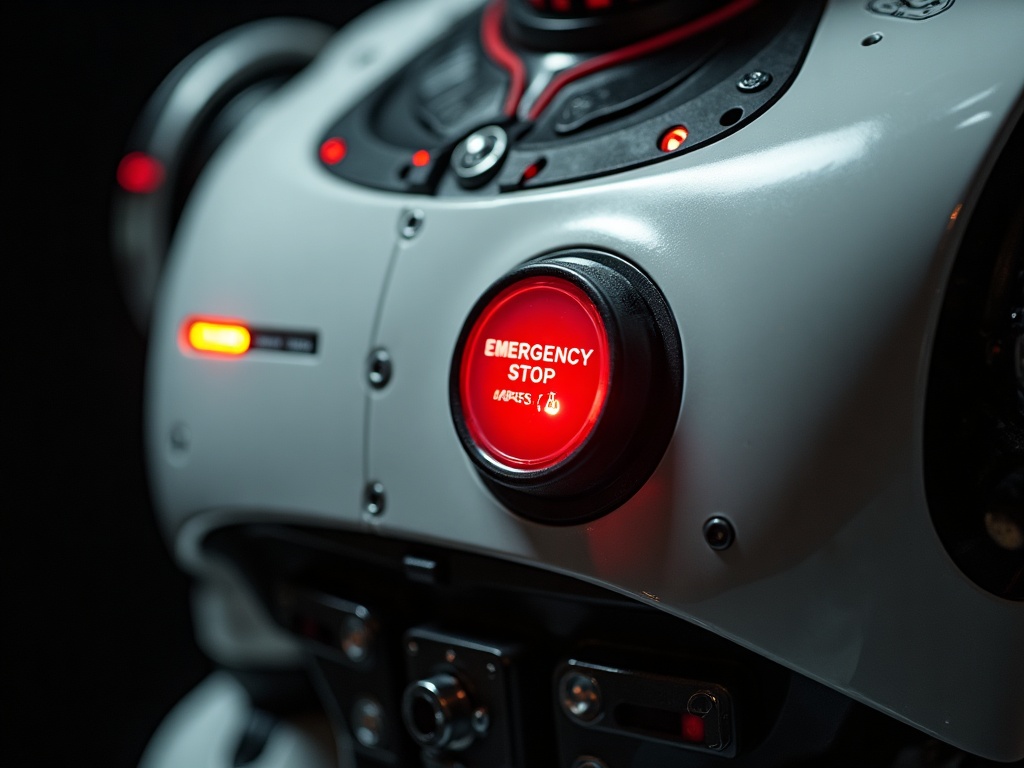
- Safety: speed limiter, e-stop, remote shutdown, attendant SOP
What it becomes (platform expansion)
- Robotics-as-a-Service subscription for venues and districts
- Sponsorship inventory for brands (events, districts, campuses)
- Urban analytics dashboard (anonymized interaction and density signals)
- Service modules: mobile charging, ticket scanning, concierge, delivery handoff
- City integrations: reporting relay + public-service interfaces
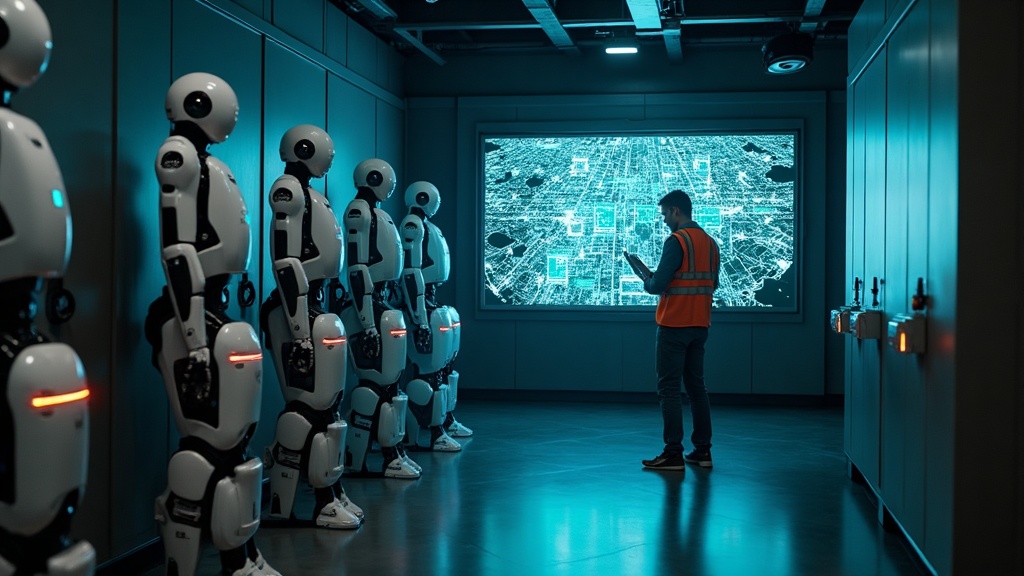
One depot, many missions
Units stage, charge, and sync at a central depot. Every mission is planned against the city map: geofence, route, attendant assignment, and inventory load-out—then monitored live from the ops console.
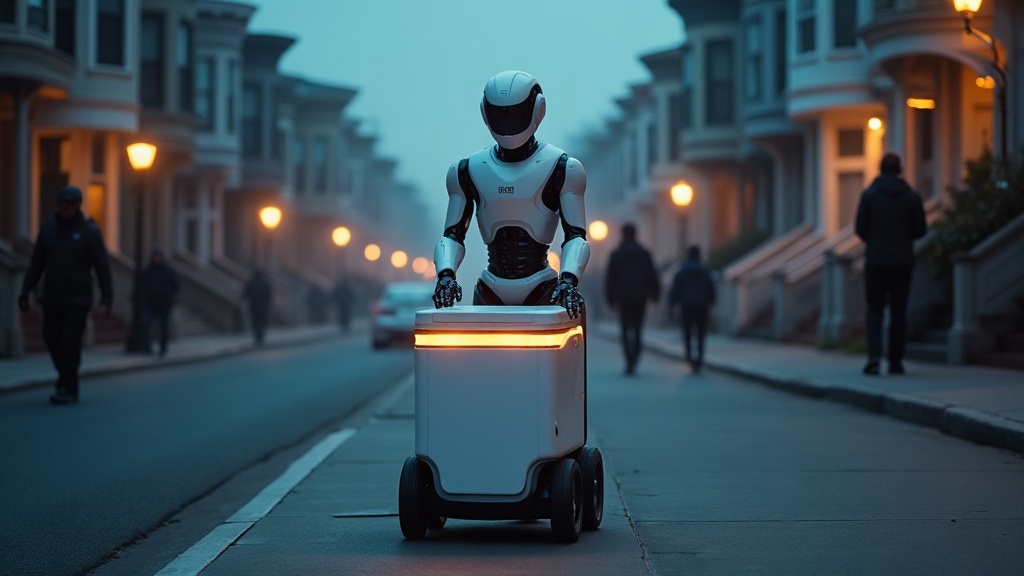
We are not building “a vending robot.” We are building the first repeatable, insured, supervised operating framework for humanoids in public life.
Retail is the wedge that funds iteration and real-world interaction data
Deployment roadmap
We win by shipping deployment infrastructure before competitors ship autonomy. The roadmap is designed to maximize learning and minimize catastrophic risk.
- 2 units deployed in controlled, private environments
- Human attendant required; geofenced routes
- Telemetry pipeline + maintenance SOPs
- Target: ≥30 transactions/day; 0 safety incidents
- 3–5 permitted events (conferences, venues, festivals)
- High-foot-traffic stress testing
- Insurance posture validation
- Target: ≥50 transactions/day at events
- No off-the-shelf permit exists for this — that's the point
- Requires a negotiated pilot agreement with city stakeholders
- We arrive at that table with 8 months of telemetry, zero incidents, and insurance in force
- Controlled district pilot (geofence + attendant), scaling to 5–10 units
- Target: ≥50 transactions/day; ≥90% uptime
Phase 3 is a negotiation, not a switch we flip. SF's only robot permit (Public Works Code Sec. 794) covers delivery R&D testing in industrial zones — not retail — so a public-sidewalk pilot needs a negotiated MOU or new legislation. We name that gate deliberately: it's exactly why 8 months of clean telemetry and active coverage matter. We also run a parallel track in San Jose, whose DOT has actually piloted cooperative sidewalk-robot programs, as a faster path to public-space validation.
Safety & compliance
Public humanoids require operational rigor: speed limits, incident response, insurance posture, ADA constraints, and stakeholder transparency. Robomodal is built to satisfy that reality.
Supervised by design
Attendant within 10–15 ft, defined intervention protocol, pre-shift inspection checklist, and incident logging. That's roughly 2x stricter than the 30 ft San Francisco's existing autonomous-device ordinance (Sec. 794) requires.
Fail-safe behavior
Speed limiter firmware, collision sensing, visible e-stop, remote shutdown, and teleoperation fallback for edge cases.
Permit-ready framing
“Human-supervised mobile retail interface system” first: private property + events → limited sidewalk pilot after validation.
Incident response guarantees
- Insured for public operation: commercial general liability at $1M per occurrence / $2M aggregate (target at deployment) — 10× the $100K floor set by U.S. personal-delivery-device statutes
- ≤60s remote shutdown capability
- Real-time monitoring of motion + proximity events
- Automatic alerting on abnormal behavior or tampering
- Documented post-incident review and remediation
Data privacy stance
- Telemetry prioritized over identity
- Anonymized interaction metrics (dwell time, distance, flow)
- Clear signage and transparent policies
- Encrypted storage + access controls
The full stack — business registration, seller's permit, SFDPH health and SFFD fire sign-off, insurance, and the sidewalk-pilot gate — is itemized by deployment mode and city on our Permits & Compliance page.
Unit economics
The wedge is profitable retail + events. The platform layer compounds upside via sponsorship and RaaS. Our model is intentionally conservative and built around supervised operations.
Per-unit monthly costs (early)
- Humanoid lease/depreciation: $2k–$4k
- Attendant labor: $4k–$5k
- Insurance allocation: $500+ — targeting $1M per-occurrence / $2M aggregate general liability, 10× the $100K floor set by personal-delivery-device statutes nationwide
- Ops + storage + maintenance: $2k+
Early systems are labor-heavy by design. The path is reducing interventions and increasing throughput.
Per-unit daily revenue targets
- Break-even (early): $350–$500/day
- Events + sponsorship accelerate early profitability
- Platform add-ons create step-function expansion
Retail is the wedge; the scalable value is the deployment playbook + data + enterprise pilots.
Invest in Robomodal
We’re raising a $200k–$400k pre-seed to secure pilot LOIs, insurance underwriting posture, legal classification guidance, the smart-cooler prototype, and initial supervised deployments in SF.
Legal + compliance • Insurance underwriting • Prototype cooler module • Pilot LOIs • Telemetry backend
1 private property LOI • 1 event partner • underwriting interest • hardware shortlist • 2-unit pilot plan
Public humanoid deployment is under-defined—first mover sets precedent, trust, and a replicable playbook.
By submitting, you agree to be contacted by Robomodal. No spam. We keep outreach minimal and high-signal.